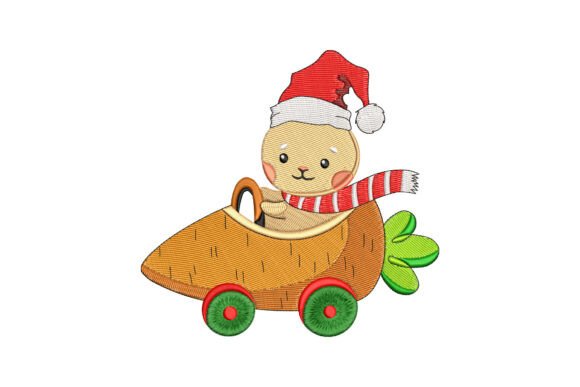
Bunny Driving Carrot Car Christmas: A Guide to Premium Embroidery Success
The holiday season offers a unique opportunity to infuse whimsy and warmth into your creative projects, and few designs capture that spirit quite like the Bunny Driving Carrot Car Christmas motif. This charming illustration blends traditional festive elements with playful, modern storytelling, making it a standout choice for seasonal decor and apparel. However, the difference between a professional-looking finish and a tangled mess of thread often lies not in the design itself, but in how it is selected, prepared, and stitched. Many enthusiasts rush into downloading and stitching without considering the technical nuances, leading to avoidable frustrations.
Understanding the intricacies of this specific embroidery pattern can save you time, money, and material. Whether you are a seasoned professional running a small business or a beginner just acquiring your first machine, approaching this project with a critical eye ensures superior results. Let’s explore the common pitfalls associated with this design and how to navigate them effectively.
Understanding the Design Complexity
At first glance, the Bunny Driving Carrot Car Christmas appears to be a simple, cute graphic. It features a bunny character steering a vehicle shaped like a carrot, often adorned with holiday accessories. This simplicity is deceptive. The design typically involves multiple color changes, varying stitch densities, and potentially small text or detailed facial features. For beginners, the assumption that "cute equals easy" is the first mistake. Complex color transitions require precise tension settings and careful trimming. If you overlook the density map provided with premium files, you may encounter puckering on lightweight fabrics or thread breaks on heavier materials.
Experienced creators know that the visual appeal of this design relies heavily on the contrast between the orange of the carrot, the white or brown of the bunny, and the background fabric. Choosing a fabric that clashes with these colors or fails to support the stitch count can diminish the impact. For instance, stitching this design on a thin cotton tee without proper stabilization will likely result in distortion, where the carrot shape warps and the bunny’s features become unrecognizable.
Common Mistakes in File Selection and Compatibility
One of the most frequent errors occurs before the needle even touches the fabric: selecting the wrong file format or size. Premium embroidery designs, such as this bunny motif, usually come in multiple formats (DST, PES, JEF, EXP, etc.) to accommodate various machine brands. A common misunderstanding is that all files are universal. While many modern machines are versatile, using a converted file rather than the native format for your specific machine can lead to lost data, such as jump stitches or color stop commands.
Furthermore, resizing is a critical area where mistakes happen. Unlike vector graphics, embroidery files cannot be scaled up or down significantly without compromising stitch integrity. If you attempt to enlarge the Bunny Driving Carrot Car Christmas design by more than 10-15%, the stitch density becomes too sparse, revealing the backing material. Conversely, shrinking it too much causes the stitches to overlap excessively, creating a bulky, stiff patch that may damage delicate fabrics. Always check the included size chart and choose the version that closest matches your desired dimensions.
Stabilization and Hooping Errors
Even with the perfect file, poor stabilization can ruin the final product. This design, with its mix of satin stitches (likely for the carrot body) and fill stitches (for the bunny’s fur), requires balanced support. A frequent oversight is using the same stabilizer for every project. For knit fabrics, a cut-away stabilizer is essential to prevent stretching during wear. For woven linens, a tear-away might suffice, but only if the fabric is tightly woven.
Hooping technique is another area where precision matters. If the fabric is not drum-tight, the design will shift, causing misalignment between the carrot wheels and the body. This is particularly problematic for designs with distinct geometric shapes. Ensure that your hoop is secure and that the grain of the fabric is straight. Using floating techniques with adhesive spray can also help maintain stability for smaller items like ornaments or patches, preventing the fabric from slipping during high-speed stitching.
Thread Quality and Tension Management
The vibrancy of the Bunny Driving Carrot Car Christmas design depends heavily on thread quality. Cheap threads often fray, break, or fade after washing, detracting from the professional look. Investing in high-quality rayon or polyester embroidery thread ensures sheen and durability. Additionally, tension settings must be adjusted for each thread type. If the top tension is too tight, the bobbin thread may pull to the surface, creating unsightly dots around the carrot’s edges.
Test stitching is non-negotiable. Always run a test on a scrap piece of the same fabric with the same stabilizer. This allows you to verify color accuracy, check for thread breaks, and ensure the design centers correctly. Skipping this step to save time often results in wasted materials and disappointed customers or recipients.
Maximizing Versatility Across Projects
This premium embroidery design is not limited to t-shirts. Its versatility allows for application on various items, including tote bags, pillowcases, kitchen towels, and even denim jackets. However, each substrate presents unique challenges. When stitching on thick materials like denim or towels, consider using a topping material to prevent stitches from sinking into the pile. For delicate linens, use a lightweight stabilizer and reduce machine speed to minimize perforation.
For entrepreneurs and small business owners, offering this design on diverse products can expand market appeal. However, consistency is key. Ensure that the design looks equally polished on a mug cozy as it does on a onesie. This requires adjusting hooping methods and possibly using different needle sizes. A universal 75/11 needle works for most medium-weight fabrics, but a ballpoint needle is necessary for knits to avoid snagging fibers.
Final Checks Before You Stitch
Before committing to your final piece, review the following checklist:
- File Format: Confirm you are using the native format for your machine.
- Size Accuracy: Verify dimensions match your intended item without excessive resizing.
- Fabric Choice: Ensure the material complements the design’s colors and supports the stitch density.
- Stabilization: Select the appropriate stabilizer type (cut-away, tear-away, or wash-away) based on fabric stretch and weight.
- Thread Quality: Use fresh, high-quality thread to prevent breaks and ensure vibrant colors.
- Test Run: Always stitch a sample to check tension, alignment, and overall appearance.
By addressing these common issues proactively, you transform the Bunny Driving Carrot Car Christmas from a simple digital file into a cherished handmade item. Attention to detail separates amateur attempts from professional craftsmanship. Embrace the learning process, respect the technical requirements of machine embroidery, and enjoy the satisfaction of creating something truly special this holiday season.